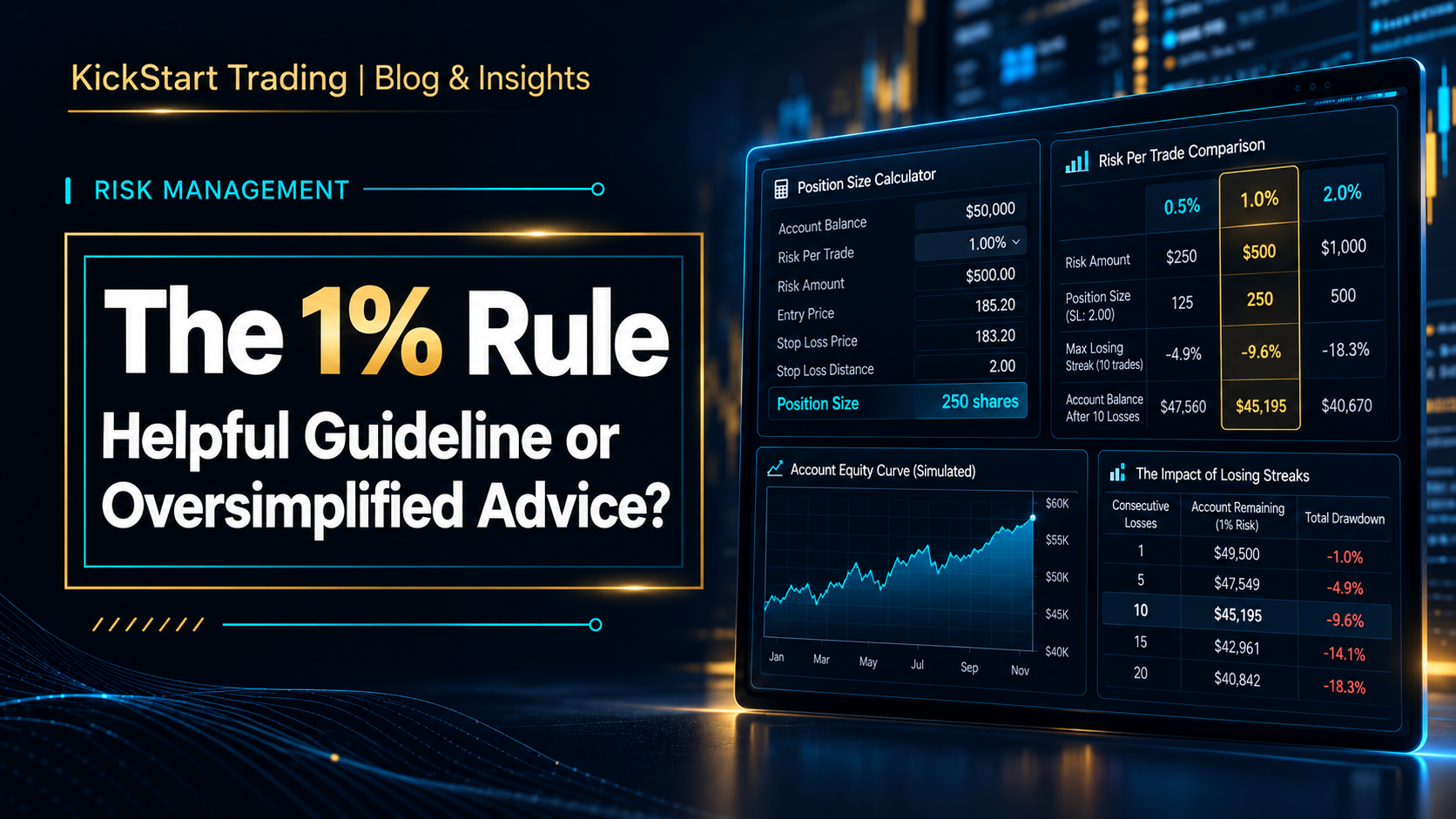
The 1% Rule: Helpful Guideline or Oversimplified Advice?
If you spend any time around trading education, risk management content, or funded-account discussions, you will quickly hear one idea repeated over and over again:
Risk 1% per trade.
It is presented as a clean, simple, sensible rule.
And in many ways, it is.
The 1% rule gives traders an easy starting point for thinking about risk. It encourages structure. It discourages reckless oversizing. It helps newer traders understand that every trade should have a defined downside.
That is all positive.
But like many popular trading ideas, the 1% rule can also become too simplistic when people repeat it without context.
Some traders treat it as universal truth.
Others reject it completely.
The better approach is to understand what the 1% rule actually does, what problem it solves, and when it may or may not fit the account being traded.
What is the 1% rule?
The 1% rule means a trader chooses to risk no more than 1% of account equity on a single trade.
If a trader has a $10,000 account, then 1% represents $100.
That means the maximum planned loss on one trade would be $100.
If the stop loss is hit, the loss should remain close to that amount, before any small differences caused by slippage or costs.
If the trader has a $25,000 account, 1% is $250.
If the trader has a $100,000 account, 1% is $1,000.
The percentage stays the same.
The actual money amount changes with the account size.
This is why the 1% rule is really a position sizing framework rather than a magic number.
It is a way of scaling risk relative to the account.
Why the 1% rule became so popular
The 1% rule became popular for good reasons.
First, it is simple.
A lot of traders need a starting point. When someone is new, it is easier to understand “risk 1%” than it is to think about distribution of outcomes, expected drawdown, volatility-adjusted sizing, or risk-of-ruin modelling.
Second, it encourages discipline.
A trader who limits risk to 1% is usually in a much better position than a trader who risks 5%, 10%, or some completely random amount whenever a setup looks exciting.
Third, it helps protect accounts from catastrophic single-trade damage.
One bad trade should not destroy weeks or months of work.
The 1% rule helps prevent that.
Fourth, it creates repeatability.
By standardising risk, traders can compare trades more clearly, analyse results more honestly, and judge strategy performance with less distortion.
These are strong advantages.
The rule is popular because it often moves traders in a healthier direction.
What problem does the 1% rule solve?
The 1% rule solves a very common trader problem:
Too much risk on one idea.
Many traders focus heavily on being right.
They assume the key variable is entry quality.
But no setup is guaranteed.
A strong setup can still lose.
A clean chart can still fail.
A good week can still begin with two losing trades.
The 1% rule forces the trader to respect uncertainty.
It says:
Even if this setup looks good, I will not allow one trade to do excessive damage.
That is valuable because trading is not a single-event game. It is a probability game played across a series of outcomes.
If a trader risks too much on one trade, they reduce their ability to let that series play out.
The main strength of the 1% rule: account survivability
The clearest benefit of the 1% rule is survivability.
A trader who loses 1% on one trade is still very much alive.
A trader who loses 10% on one trade is already in a completely different situation.
Large losses create practical and psychological pressure.
The account now needs stronger recovery.
The trader may become more emotional.
The temptation to force the next trade increases.
This is why serious trading is not just about return. It is about damage control.
To understand this, compare a few simple examples.
If a trader loses:
- 1%, the account needs roughly 1.01% to recover
- 5%, the account needs roughly 5.26% to recover
- 10%, the account needs roughly 11.11% to recover
- 20%, the account needs 25% to recover
- 50%, the account needs 100% to recover
This is why smaller losses matter so much.
The 1% rule supports a more survivable game.
If you want to understand how losses change the recovery required, the free KickStart Drawdown Calculator is useful for seeing the relationship in actual numbers.
The 1% rule is not really about 1%
This is one of the most important points.
The 1% rule is often spoken about as if the exact number itself is sacred.
It is not.
The real lesson behind the rule is:
Use a small, predefined, repeatable percentage of account equity.
That percentage might be 1%.
It might also be:
- 0.25%
- 0.5%
- 0.75%
- 1.25%
- Something else defined clearly in the plan
The concept matters more than the specific percentage.
If a trader hears “1% rule” and assumes 1% must automatically be correct for every account and every style, they have misunderstood the purpose of the rule.
When the 1% rule is genuinely helpful
The 1% rule is often helpful in at least five situations.
1. It gives new traders a guardrail
Many beginners do not yet have a stable framework for risk.
They may size trades emotionally. They may take larger positions after a win or after a streak of good setups. They may not think carefully enough about what a loss actually means.
A simple 1% cap can bring immediate structure.
It is not perfect, but it is better than chaos.
2. It prevents “all-in thinking”
Some traders quietly operate as if one trade must prove something.
That mindset leads to oversized positions.
The 1% rule helps reduce the temptation to place exaggerated importance on a single outcome.
3. It supports consistent journaling and review
When risk is standardised, it becomes easier to compare trades. One loss is not inflated simply because the trader traded far too large. One win is not exaggerated because the trader doubled size impulsively.
This makes review more honest.
If you are reviewing your trade process, position sizing consistency matters just as much as chart quality.
4. It usually works better than arbitrary lot size
A trader who always uses “one lot” or “two contracts” regardless of stop distance is not managing risk properly.
The 1% rule at least forces the trader to calculate size relative to the account and the stop loss.
If you want help with the actual sizing process, the KickStart Position Size Calculator is built specifically for that purpose.
5. It often reduces emotional volatility
When a trader knows in advance that one trade can only do limited damage, it is often easier to stay calmer and execute the plan more cleanly.
The size may still matter.
But it is less likely to become overwhelming.
When the 1% rule can be too simplistic
Despite its strengths, the 1% rule can become oversimplified when it is repeated without context.
Here are some of the most common problems.
1. It ignores account structure
Not all accounts behave the same way.
A personal swing-trading account is not the same as a funded account with a tight trailing drawdown.
A futures account is not the same as an equities account.
A small personal account may behave very differently from a larger account.
If the account structure is restrictive, 1% may already be too aggressive.
2. It ignores realistic losing streaks
One trade is never the full story.
The relevant question is:
What happens if the trader loses five trades in a row? Or eight? Or ten?
If a strategy has natural variance, a 1% risk may be entirely manageable.
But if the trader is operating in a very tight funded environment, 1% may leave too little room for normal adversity.
This is why risk should be judged across a sequence, not just on a single trade.
3. It can create false confidence
Some traders think:
“If I risk 1%, I am being professional.”
Not necessarily.
A badly placed stop, poor trade quality, weak execution, or inconsistent process can still damage the account even if each trade risks only 1%.
The 1% rule is not a substitute for edge.
It is a tool for managing risk around the edge.
4. It may still be too large psychologically
Some traders discover that a 1% loss affects them far more than expected.
The account may survive it mathematically, but the trader may still struggle emotionally.
They may hesitate on the next setup. They may interfere with trades. They may try to win it back too quickly.
If 1% creates emotional instability, then 1% may be too much for that trader, at least for now.
5. It can be too much for funded traders
This is a major one.
A trader with a funded account often has strict loss boundaries. Risking 1% may sound disciplined in a general educational context, but in a funded environment it can still be too aggressive.
If five losses place the account in serious danger, the trader has very little room to let normal variance play out.
That is not always a good structure.
The funded-account perspective
The 1% rule sounds sensible on paper, but funded trading changes the conversation.
Suppose a funded account has a 5% maximum drawdown.
If a trader risks 1% per trade, then five full losses put the account at the limit.
Even four losses create substantial pressure.
Now imagine the trader also has a daily loss limit to respect.
The room becomes tighter still.
That does not mean 1% is always wrong in funded trading.
It means the rule must be evaluated in context.
A funded trader may decide that 0.25% or 0.5% creates a healthier risk profile. That smaller percentage may leave more room for losing streaks, mistakes, and normal market noise.
This is especially important if the trader is still building consistency.
Funded trading is not just about being profitable.
It is about surviving the rules while remaining disciplined enough to perform over time.
Daily loss limits change the calculation
The same principle applies to daily loss planning.
A trader might hear that an account allows a 5% daily loss limit and think 1% per trade is automatically conservative.
But that depends on the number of trades, the quality of execution, and the trader’s behaviour after losses.
If a trader risks 1% per trade and takes four losing trades in one day, the damage may already be significant.
A trader who risks 0.5% may have more room to manage the day with discipline.
This is why many serious traders create a personal daily stop that is much smaller than the official platform or firm limit.
The official rule is an outer boundary.
The trader’s own plan should be tighter.
The Drawdown Calculator and your overall risk plan should work together here.
The 1% rule does not replace proper position sizing
This is another misconception.
Some traders say, “I risk 1%,” but they still do not size trades correctly.
Risk percentage is only one part of the process.
You also need:
- Entry price
- Stop loss
- Distance between entry and stop
- Instrument value
- Position size calculation
The sequence matters.
A trader should not decide to “risk 1%” and then guess the lot size.
The stop has to make sense technically, and the position size has to be calculated so that the stop-out produces the intended monetary loss.
If you have not worked through this process yet, it is worth reading Position Sizing Explained: How Much Should You Risk Per Trade? alongside using the Position Size Calculator.
Different strategies may justify different risk
Not every strategy behaves the same way.
A trader taking high-frequency intraday setups may think about risk differently from a trader taking selective swing trades.
A trader with a strategy that has a high win rate but modest reward may approach sequences differently from a trader using lower win-rate, higher-R multiple setups.
This does not automatically mean risk should vary trade by trade based on feeling.
It does mean the broader strategy profile matters.
A fixed 1% risk may be completely appropriate for one system and less suitable for another.
That is why context beats slogans.
Should you risk less than 1%?
Very often, yes.
There is nothing weak or “too conservative” about risking less than 1%.
In fact, for many traders, less than 1% is probably more realistic.
Situations where smaller risk may make sense include:
- You are new and still building execution discipline
- You are testing a strategy live
- You are trading a funded account
- You are coming off a bad period
- You are emotionally sensitive to drawdown
- You are trading in volatile conditions
- You are trying to protect consistency more than maximise speed
Common lower-risk frameworks include 0.25% and 0.5%.
These smaller percentages may feel slow, but they often make it easier to execute cleanly and stay in the game long enough to improve.
Should you ever risk more than 1%?
Possibly, but that decision should not be casual.
Some experienced traders do occasionally risk more than 1% in specific frameworks.
But if risk goes above 1%, the trader should understand the consequences very clearly.
Higher risk increases:
- drawdown speed
- emotional pressure
- recovery demands
- chance of violating daily or maximum loss rules
- sensitivity to losing streaks
The decision should be part of a documented plan, not an emotional reaction to a setup that feels especially good.
In most developing traders, increasing risk is not the missing ingredient.
Better process is.
What matters more than the exact percentage
If a trader becomes too focused on whether the number should be 1%, they can miss the bigger point.
The more important questions are:
- Is my risk predefined?
- Is my position size calculated properly?
- Can my account survive a normal losing streak?
- Does my risk fit the rules of the account?
- Can I execute cleanly at this size?
- Does this risk level keep me emotionally stable?
- Is this consistent with my written plan?
A trader who risks 0.5% intelligently may be in a much stronger position than a trader who blindly risks 1% because that is what social media says serious traders do.
The psychological side of the 1% rule
There is a reason traders obsess over finding the “right” percentage.
Risk feels personal.
Money changes emotion.
The 1% rule appeals to people partly because it sounds balanced and professional.
But the real test is not whether it sounds good.
The real test is whether it supports good behaviour.
Does it help the trader remain patient?
Does it reduce panic?
Does it allow the trader to accept losses without spiralling?
Does it preserve objectivity?
If the answer is yes, the rule may be serving its purpose.
If the answer is no, the trader may need to adjust.
Risk is not only mathematical.
It is behavioural.
A useful way to think about the 1% rule
Instead of asking:
“Should I always risk 1%?”
Try asking:
“Would risking 1% still feel sensible after six consecutive losses?”
Or:
“Would risking 1% still fit my account if I have two bad days in the same week?”
Or:
“Would risking 1% help me stay composed, or would it make me trade emotionally?”
These questions are more useful because they connect the rule to real trading conditions.
Good risk management is not built around perfect scenarios.
It is built around realistic ones.
A practical framework for using the rule wisely
Here is a more useful framework than simply copying “1%” without thought.
Step 1: Define your account constraints
Understand the size of the account, the daily stop, the maximum drawdown, and any funded-account rules that matter.
Step 2: Define your emotional tolerance
Ask honestly whether a full-risk loss at this size would feel acceptable and manageable.
Step 3: Review your strategy’s normal behaviour
Consider the typical losing streaks and the variability of outcomes.
Step 4: Choose a small risk percentage
That might be 1%, but it may also be 0.5% or lower.
Step 5: Calculate the position correctly
Use a proper position size calculation rather than guessing the exposure.
Step 6: Review the rule after real data
After a meaningful sample of trades, assess whether the chosen percentage is helping or hurting your performance and discipline.
This is how the 1% rule becomes useful.
Not as a slogan.
As a tested part of a broader process.
Final thoughts
The 1% rule is neither a myth nor a law.
It is a helpful guideline.
For many traders, especially those who need a simple starting framework, it can be a very useful one.
It encourages discipline.
It limits single-trade damage.
It supports account survival.
But it becomes oversimplified when people treat it as universally correct without reference to account structure, strategy behaviour, emotional tolerance, or funded-account rules.
The important principle is not that every trader must risk exactly 1%.
The important principle is that risk should be small, predefined, calculated properly, and appropriate for the account being traded.
For some traders, that may be 1%.
For others, it may be 0.5%, 0.25%, or something similarly controlled.
The number matters less than the thinking behind it.
If you want to apply the concept properly, start by defining your risk in money terms, place a technically valid stop, and then calculate the correct size with the KickStart Position Size Calculator.
To your health, wealth, and happiness, always,
Chris