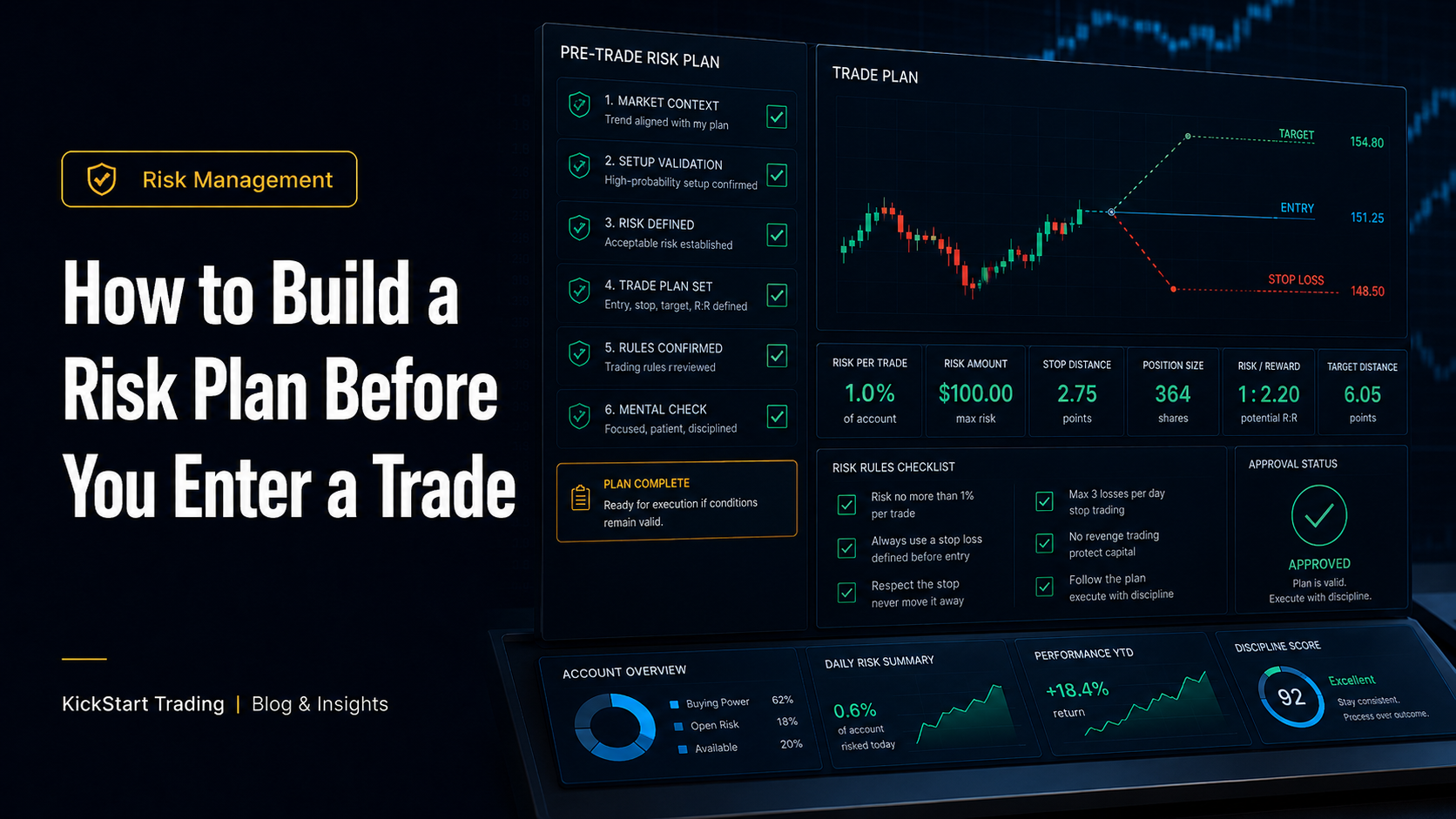
Most trading mistakes begin before the trade is placed.
Not after.
Before.
A trader sees a setup, feels urgency, enters quickly, and only then starts thinking properly about risk.
Where should the stop go?
How much am I risking?
What happens if this trade loses?
Should I move the stop?
Should I add another position?
What if the market reverses?
That is backwards.
A serious trader builds the risk plan before entering the trade.
The entry is not the beginning of the decision-making process.
It is the result of the decision-making process.
Risk comes before reward
Most traders naturally focus on reward.
They look at how far the market could move. They imagine the profit. They think about how much the trade could make.
That is understandable.
But professional trading starts with risk.
Before asking how much a trade could make, the trader needs to ask:
How much can this trade lose?
That question changes everything.
It forces the trader to think clearly. It creates boundaries. It stops the trade from becoming emotional once money is involved.
Profit is the potential outcome.
Risk is the responsibility the trader accepts before entering.
Define the trade idea first
A risk plan begins with a clear trade idea.
That means the trader should know why the trade exists.
Not vaguely.
Clearly.
For example:
- The market is pulling back into a key level
- Price is reacting from support or resistance
- The trade aligns with trend structure
- There is confluence across multiple timeframes
- The setup fits the trader’s strategy
- The entry is not based on emotion or chasing
If the trader cannot explain why the trade is valid, they probably should not take it.
A trade without a clear idea is usually just a reaction.
And reactive trading is where many risk mistakes begin.
Know your invalidation point
Every trade needs an invalidation point.
The invalidation point is the level or condition that proves the trade idea is no longer valid.
This is different from randomly placing a stop loss.
A proper stop should be based on the trade idea.
If the trader is buying because price is holding a support level, the invalidation point may be where that support clearly fails.
If the trader is selling because the market is respecting a lower-high structure, the invalidation point may be where that structure breaks.
The stop loss should answer a simple question:
Where am I wrong?
If the trader does not know where they are wrong, they do not have a complete risk plan.
Set the stop before entering
The stop loss should be planned before the trade is placed.
Not after.
A trader who enters without a stop often starts negotiating emotionally once the market moves.
They may say:
I will just give it more room.
The market is probably coming back.
I do not want to close at the low.
The stop is too obvious.
I will move it just a little further.
That behaviour turns a planned trade into an uncontrolled loss.
A stop loss is not there to predict the perfect exit.
It is there to define the maximum acceptable damage if the trade idea fails.
That definition must happen before the trade is live.
Calculate position size properly
Once the stop is defined, the trader can calculate position size.
Position size should be based on:
- Account size
- Risk percentage
- Stop distance
- Instrument value
- Account rules
- Maximum daily loss
- Current drawdown
- Market conditions
Many traders get this wrong.
They choose lot size first and think about stop distance second.
That is dangerous.
The correct process is:
- Decide how much you are willing to risk.
- Identify where the stop needs to go.
- Calculate the position size that fits that risk.
If the stop is wider, the position size should usually be smaller.
If the stop is tighter, the position size may be larger, but only if the stop still makes technical sense.
Position sizing connects the chart idea to account protection.
Risk percentage should fit the account
Not every trader should risk the same amount.
Some traders risk 0.25% per trade. Others may risk 0.5%, 1%, or more depending on their strategy, account size, experience, and rules.
But the risk percentage must fit the account structure.
A trader using a funded account needs to consider:
- Daily loss limit
- Maximum drawdown
- Static or trailing drawdown
- Number of trades likely per day
- Losing streak potential
- Emotional tolerance
- Whether the account is in profit or drawdown
Risking too much can make even a normal losing streak dangerous.
A trader who risks too aggressively may not survive long enough for their edge to play out.
That is why risk percentage is not just a number.
It is a survival decision.
Check the daily loss limit
Before entering a trade, especially on a funded account, the trader must know where they stand relative to the daily loss limit.
If the account is already down for the day, the next trade carries more pressure.
A trade that would normally be acceptable may become too risky if it brings the account too close to the daily stop.
Before entering, ask:
- How much have I lost today?
- How much room remains before my personal daily stop?
- How much room remains before the account’s official daily loss limit?
- Would this trade put the account under unnecessary pressure?
- Should risk be reduced?
- Should I stop trading for the day?
The official daily loss limit should be treated as an emergency boundary.
A serious trader should usually have a personal stop before that level.
Understand the drawdown impact
Every trade affects drawdown.
That is especially important in funded trading.
Before entering, the trader should understand what happens if the trade loses.
Will the loss be normal and manageable?
Will it put the account near maximum drawdown?
Will it reduce the trader’s ability to take future setups?
Will it create emotional pressure?
Will it cause the trader to abandon the plan?
A trade may look technically valid, but if the account is already under drawdown pressure, the risk may need to be reduced.
The chart is not the only factor.
The account condition matters too.
Define the target before entering
A risk plan should also include the target.
The trader should know where the trade is likely to go if it works.
That does not mean the market must reach the target.
It means the trader has a plan.
A good target may be based on:
- Previous highs or lows
- Support or resistance
- Fibonacci extensions
- Market structure
- Liquidity areas
- Risk-to-reward profile
- Higher-timeframe context
The target helps the trader judge whether the trade is worth taking.
If the potential reward is too small compared with the risk, the trade may not be attractive.
Not every valid setup is worth taking.
Think beyond simple risk-to-reward
Risk-to-reward is important, but traders should not use it mechanically.
A 1:3 trade is not automatically good.
A 1:1 trade is not automatically bad.
The quality of the setup matters.
The probability of the trade matters.
The market context matters.
The trader’s execution history matters.
A trader should ask:
Is this target realistic?
Is the stop logical?
Does the trade have enough room to move?
Am I forcing the reward to look better than it really is?
Risk-to-reward should support the decision.
It should not replace thinking.
Decide what would make you exit early
Sometimes a trade may need to be exited before the stop or target.
That should also be planned.
For example:
- The market breaks structure against the trade
- A major news event is approaching
- Price action changes dramatically
- The trade was entered incorrectly
- The trader realises the setup was invalid
- The account is too close to a daily stop
- The trader becomes emotional and cannot manage the position properly
The key is to define these scenarios before they happen.
Otherwise, the trader may exit emotionally or refuse to exit when they should.
A risk plan creates clarity.
Plan what happens after a loss
A serious trader knows what they will do if the trade loses.
Will they take another setup?
Will they reduce risk?
Will they stop for the day?
Will they review the trade first?
Will they wait for a fresh structure?
This matters because losses affect emotion.
After a loss, the temptation to recover can become strong.
If the trader has no post-loss rule, they may start reacting.
A simple rule can help:
After one full-risk loss, reduce risk or pause.
After two losses, stop trading for the session.
After a mistake-based loss, stop immediately and review.
The exact rule can vary.
But there should be a rule.
Plan what happens after a win
Winning trades can also create risk.
After a win, traders may become overconfident.
They may think they are seeing the market clearly. They may increase size, take lower-quality setups, or chase another win.
This is the confidence trap.
A risk plan should define behaviour after wins as well as losses.
For example:
- Do not increase risk after one win
- Do not take a second trade unless it fully meets the plan
- Do not give back more than a set amount of profit
- Stop after reaching the daily goal
- Review whether the win was process-based or lucky
Winning does not remove the need for discipline.
Sometimes it makes discipline even more important.
Check the news calendar
Before entering a trade, check for relevant news.
Major economic releases can create volatility, slippage, spread widening, and unexpected price movement.
This is especially important for traders in forex, gold, indices, futures, and funded accounts.
Some funded accounts have specific news trading rules.
A trader needs to know whether they are allowed to open, close, or hold trades around news events.
Before entering, ask:
- Is there high-impact news soon?
- Does this instrument usually react strongly to that news?
- Am I allowed to trade through it?
- Does the potential volatility fit my stop size?
- Should I wait until after the release?
Ignoring news risk can turn a reasonable trade into unnecessary exposure.
Write the plan down
A risk plan does not need to be complicated.
But it should be written down.
Before entering, a trader can quickly record:
- Trade direction
- Entry reason
- Stop level
- Target level
- Risk amount
- Position size
- Invalidation point
- Daily loss status
- News risk
- Emotional state
This can be done in a journal, spreadsheet, trading platform notes, or even a simple checklist.
Writing the plan down forces the trader to slow down.
That pause can prevent impulsive trades.
Use a pre-trade checklist
A pre-trade checklist helps turn discipline into a repeatable process.
It might include questions like:
- Does this setup match my strategy?
- Is the market condition clear?
- Do I know my invalidation point?
- Is my stop logical?
- Is my position size correct?
- Does the risk fit my daily limit?
- Is the target realistic?
- Is there high-impact news nearby?
- Am I calm enough to trade?
- Am I entering because of the plan, not emotion?
If the trader cannot answer yes to the right questions, the trade should probably be skipped.
Skipping a trade can be a profitable decision if it prevents a bad loss.
Avoid changing the plan mid-trade
Once the trade is live, the trader should avoid changing the plan without a valid reason.
Moving the stop because the market is close to hitting it is not a valid reason.
Increasing risk because the trade “looks good” is not a valid reason.
Adding impulsively because the trader wants a bigger win is not a valid reason.
A plan can be adjusted if new information genuinely changes the trade idea.
But many mid-trade changes are emotional, not logical.
That is why the plan must be clear before the entry.
The clearer the plan, the less room there is for emotional negotiation.
The risk plan protects your future trades
A risk plan does not only protect one trade.
It protects the trader’s ability to keep trading.
One uncontrolled trade can damage the account, confidence, and decision-making.
A controlled loss is manageable.
An uncontrolled loss can change everything.
The purpose of a risk plan is not to avoid all losses.
Losses are part of trading.
The purpose is to make sure losses stay within acceptable limits.
That is how traders survive long enough to improve.
Risk planning and funded accounts
Funded accounts make risk planning even more important.
When trading a funded account, the trader must manage both the market and the rule structure.
That means every trade should be considered in relation to:
- Profit target
- Daily loss limit
- Maximum drawdown
- Consistency rules
- News rules
- Holding rules
- Payout eligibility
- Account scaling
A trade that might be acceptable on a personal account may not be acceptable within a specific funded-account structure.
That is why preparation matters before buying and before trading.
If you are still deciding which route fits you, read our guide to every KickStart Trading funding path.
Final thoughts
A risk plan should exist before the trade is placed.
Not after.
A serious trader knows where they are wrong, how much they are risking, where they are targeting, when they will stop, and what they will do if the trade wins or loses.
That clarity protects the account.
It also protects the trader from emotional decision-making.
Trading will always involve uncertainty.
But your risk does not need to be uncertain.
Plan it first.
Respect it during the trade.
Review it after.
That is how serious traders build discipline one decision at a time.
To your health, wealth, and happiness, always,
Chris