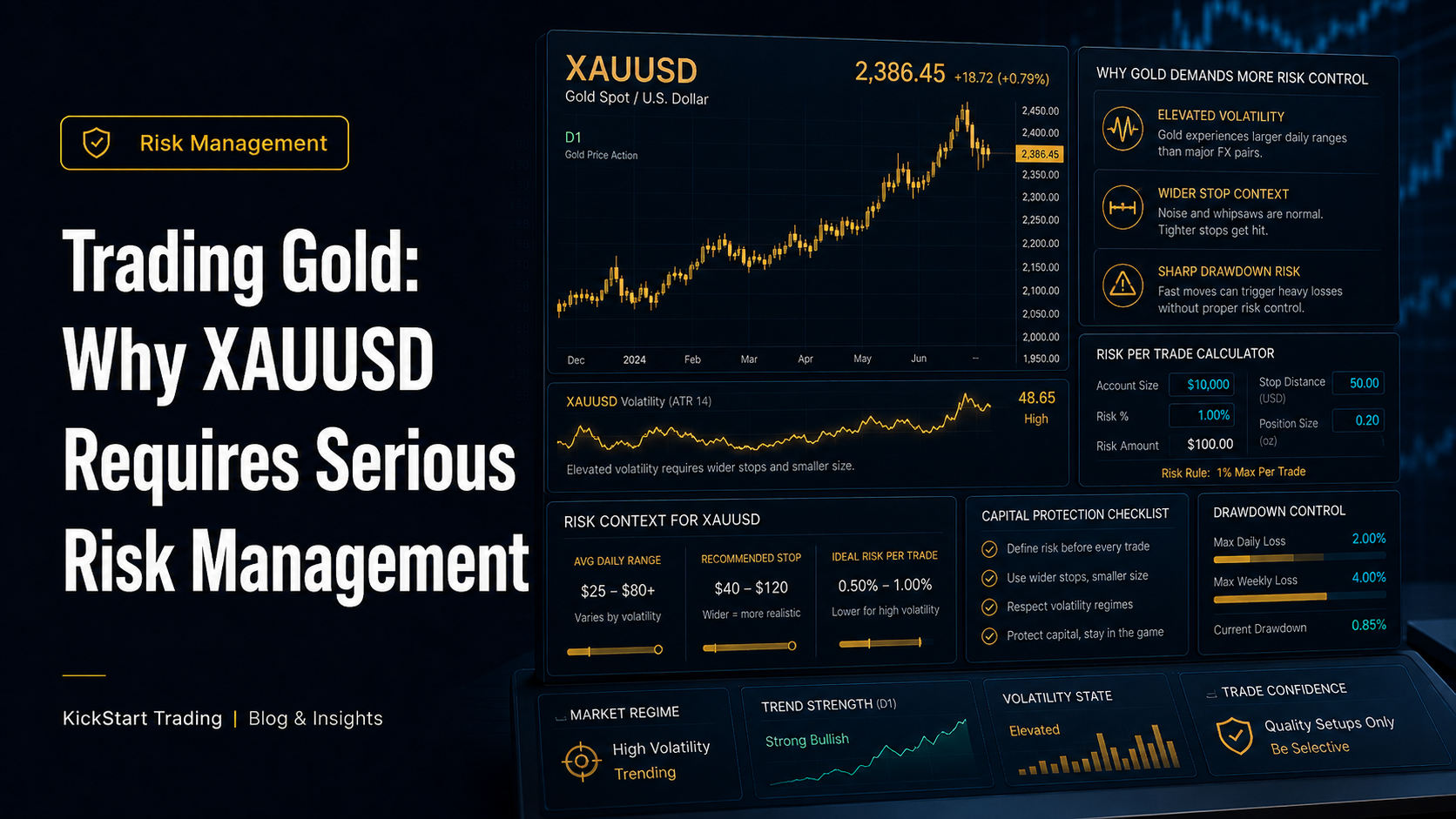
Trading Gold: Why XAUUSD Requires Serious Risk Management
Gold is one of the most exciting markets to trade.
It moves.
It trends.
It reacts to news.
It respects technical levels beautifully at times.
It can produce clean opportunities for traders who understand structure, volatility, and risk.
But gold can also be unforgiving.
XAUUSD is not a market to approach casually.
It can move quickly, reverse sharply, spike through levels, punish oversized positions, and expose poor discipline faster than many traders expect.
That is why trading gold requires serious risk management.
Not optional risk management.
Serious risk management.
Gold moves differently
Gold does not always behave like a major forex pair.
It can move aggressively within short periods.
It can react strongly to economic data, inflation expectations, interest-rate expectations, geopolitical uncertainty, dollar strength, and broader risk sentiment.
For traders, that creates opportunity.
But it also creates danger.
A move that looks small on the chart can represent meaningful account risk if the position size is too large.
A stop that looks “reasonable” may still need to be wider than the trader is used to.
A quick spike can trigger poor entries, emotional exits, or unnecessary stop-outs.
Gold can be beautiful to trade, but it demands respect.
Volatility is both opportunity and risk
Volatility is one of the reasons traders are attracted to gold.
When a market moves, there is potential.
There may be cleaner swings, stronger momentum, larger targets, and more meaningful intraday movement.
But volatility cuts both ways.
The same movement that creates profit potential can also create fast losses.
If a trader is oversized, gold can damage the account quickly.
If a trader moves stops emotionally, gold can turn one bad decision into a serious drawdown.
If a trader revenge trades after a loss, gold can accelerate the spiral.
A volatile market does not forgive poor risk control.
It magnifies it.
Position sizing matters more on gold
Position sizing is critical in every market.
On gold, it becomes even more important.
A trader cannot simply use the same lot size they would use on another instrument without understanding how gold’s movement affects account risk.
The position size must be based on:
- Account size
- Risk per trade
- Stop-loss distance
- Gold’s contract specifications
- Platform settings
- Current volatility
- Account rules
- Daily loss limit
- Maximum drawdown
Many traders make the mistake of choosing position size based on what feels exciting.
That is dangerous.
The correct question is not:
How much can I make if gold runs?
The correct question is:
How much will I lose if this trade fails?
That question should be answered before entry.
Wide stops do not justify excessive risk
Gold often requires more breathing room than slower markets.
That does not mean the trader should risk more.
If the stop needs to be wider, the position size should usually be smaller.
This is one of the most important principles in gold trading.
A wider stop with the same lot size increases risk.
A trader who does not adjust size properly may accidentally risk far more than intended.
For example, if the stop distance doubles but the position size stays the same, the money at risk may also increase significantly.
That can create unnecessary danger.
The stop should be placed where the trade idea is invalid.
The position size should then be adjusted to keep risk controlled.
Gold punishes emotional entries
Gold can tempt traders into chasing.
A strong candle appears.
Price breaks a level.
Momentum looks obvious.
The trader fears missing the move.
They enter late.
Then gold pulls back sharply.
This is a common trap.
Gold’s speed can create urgency, and urgency often leads to poor entries.
A serious trader does not chase simply because gold is moving.
They wait for the setup.
They define risk.
They know where they are wrong.
They accept that missing a move is better than entering emotionally.
There will always be another opportunity.
There may not be another account if risk is ignored.
News can change everything
Gold is highly sensitive to macroeconomic events.
High-impact news can create fast movement, spread widening, slippage, and unpredictable volatility.
Events that may affect gold include:
- Inflation data
- Interest-rate decisions
- Central bank speeches
- Employment reports
- Dollar-related news
- Geopolitical developments
- Major risk-off events
A trader does not need to predict every news reaction.
But they do need to respect the risk.
Before trading gold, check the economic calendar.
Know whether major news is coming.
Understand whether your funded account allows news trading.
Know whether holding through the event fits your strategy and risk plan.
Ignoring news risk on gold can be costly.
Technical levels still matter
Gold can respect technical levels extremely well.
Support and resistance.
Supply and demand.
Fibonacci retracements.
Fibonacci extensions.
Market structure.
Trendlines.
Liquidity areas.
Previous highs and lows.
These can all be useful when building a trade idea.
But technical analysis is not a guarantee.
A level can be respected beautifully one day and sliced through aggressively the next.
That is why technical analysis must always be paired with risk management.
The level helps identify opportunity.
The stop defines risk.
The position size protects the account.
All three matter.
Gold often needs context
A gold setup should not be judged from one small timeframe alone.
Context matters.
A trader should understand:
- Higher-timeframe trend
- Key support and resistance
- Current volatility
- Session timing
- Dollar strength or weakness
- Upcoming news
- Whether price is extended
- Whether the setup has room to move
A lower-timeframe entry may look good, but if it is running directly into a major higher-timeframe level, the trade may be less attractive.
Context helps traders avoid forcing trades in poor locations.
Gold can move hard.
But location still matters.
Session timing matters
Gold often behaves differently across sessions.
Liquidity, volatility, and movement can change depending on the time of day.
Some traders focus on London.
Some focus on New York.
Some avoid certain lower-liquidity periods.
Some prefer the overlap when participation increases.
The key is not to assume every hour is equally tradable.
A trader should review their own journal and identify when their gold strategy performs best.
If most mistakes happen during a certain session, that matters.
If most good trades happen during another, that matters too.
Gold trading should be built around evidence, not habit.
Avoid overtrading gold
Because gold moves frequently, traders may feel there is always something to trade.
That can be dangerous.
A trader may take one valid setup, then another lower-quality setup, then another emotional setup.
Before long, the issue is not gold.
The issue is overtrading.
Gold can provide opportunity, but it does not require constant participation.
A serious trader should define:
- Maximum trades per session
- Maximum trades per day
- Conditions required for entry
- Personal daily stop
- Rules after losses
- Rules after wins
Without those boundaries, gold can pull traders into unnecessary activity.
Revenge trading gold is dangerous
Revenge trading is dangerous in any market.
On gold, it can be especially damaging.
The movement is fast enough that an emotional trader can lose control quickly.
One loss becomes frustration.
Frustration becomes a larger position.
The larger position becomes a bigger loss.
The bigger loss becomes desperation.
That spiral can happen quickly.
A trader who revenge trades gold is not just making a psychological mistake.
They are combining emotional decision-making with a volatile instrument.
That is a dangerous combination.
If a gold trade loses and you feel emotional, step away.
The next trade should come from the plan, not from the need to recover.
Funded accounts and gold trading
Gold can be traded within funded-account structures, but traders must be especially careful with the rules.
A funded trader trading gold needs to understand:
- Daily loss limit
- Maximum drawdown
- Static or trailing drawdown
- News trading rules
- Holding rules
- Position-size restrictions
- Consistency rules
- Spread and execution conditions
- Whether open equity affects rule calculations
Gold’s volatility can bring the account closer to rule limits faster than expected.
That does not mean gold should be avoided.
It means it must be traded professionally.
If the account rules and the trader’s gold strategy do not fit together, the trader needs to adjust or choose a different route.
Smaller risk can create better execution
Many traders think they need to risk more to make gold worthwhile.
That is not necessarily true.
In fact, smaller risk can improve execution.
When risk is too large, the trader may become emotional.
They may close too early.
They may move stops.
They may hesitate on valid setups.
They may panic during normal pullbacks.
Smaller risk can help the trader think clearly.
It gives the strategy room to work.
It reduces emotional pressure.
It helps the trader survive losing streaks.
Consistency is easier to build when the account is not constantly under threat.
Know your invalidation point
Before entering a gold trade, know exactly where the idea is wrong.
Not where you hope it will stop moving against you.
Not where the loss becomes uncomfortable.
The actual invalidation point.
For example:
- A support zone fails
- A resistance zone breaks
- Market structure shifts
- A swing high or low is taken
- Price closes beyond a key level
- The setup no longer matches the plan
The stop loss should be tied to the trade idea.
If the invalidation point is too far away for your desired risk, reduce position size or skip the trade.
Do not force the trade to fit your preferred lot size.
Let the trade breathe, but protect the account
Gold often needs room to move.
But giving a trade room does not mean abandoning control.
A trader should know:
- Where the stop is
- Why the stop is there
- How much is at risk
- Where partials may be taken
- Whether breakeven makes sense
- Where the target is
- What changes the trade idea
- What happens after a loss
This is trade management.
The goal is not to micromanage every tick.
The goal is to manage the trade according to a plan.
Gold will move.
The trader must stay structured while it does.
Do not mistake movement for opportunity
A moving market is not always a good market.
Gold may be moving aggressively, but that does not mean there is a clean trade.
Sometimes price is too extended.
Sometimes the move has already happened.
Sometimes the risk-to-reward is poor.
Sometimes the level is unclear.
Sometimes news has distorted the chart.
Sometimes the best decision is to wait.
New traders often confuse movement with opportunity.
Experienced traders understand that clean opportunity requires structure, location, risk, and timing.
Movement alone is not enough.
Journal your gold trades
If you trade gold regularly, journal it separately.
Gold may reveal patterns that differ from your other markets.
Track:
- Session time
- Setup type
- Stop distance
- Risk amount
- News environment
- Volatility conditions
- Entry quality
- Trade management
- Emotional state
- Result
- Mistakes
- Screenshots
Over time, this data can show where your gold trading is strongest and weakest.
Maybe you trade better during New York.
Maybe you lose more during news.
Maybe you overtrade after the first gold loss of the day.
Maybe your best trades come from higher-timeframe levels.
The journal reveals what memory hides.
Gold requires humility
Gold can reward traders.
It can also humble them quickly.
That is why traders need humility.
Do not assume you are bigger than the market.
Do not assume one good week means you have mastered gold.
Do not assume a level must hold.
Do not assume a move cannot reverse.
Do not assume your account can absorb emotional risk.
The market does not care how confident you feel.
The trader’s job is not to control gold.
The trader’s job is to control risk, execution, and behaviour.
The KickStart approach
At KickStart Trading, we believe gold trading should be approached with structure.
XAUUSD can be a powerful market, but it is not a toy.
It requires proper position sizing, clear invalidation, disciplined trade management, awareness of news, and respect for volatility.
A trader should not approach gold with random lot sizes, emotional entries, or revenge trading behaviour.
Gold rewards patience, preparation, and discipline.
It punishes arrogance.
That is why risk management must come first.
Final thoughts
Gold can be one of the most exciting markets to trade.
It can also be one of the most unforgiving.
XAUUSD moves quickly, reacts sharply, and exposes poor discipline fast.
That does not mean traders should fear it.
It means they should respect it.
Use proper position sizing.
Know your invalidation point.
Check the news.
Avoid chasing.
Respect daily loss limits.
Journal your trades.
Stop when emotion takes over.
Gold can offer opportunity, but opportunity without discipline is dangerous.
The serious gold trader does not ask only:
How much can I make if this runs?
They ask:
How much risk am I accepting, and can I manage it professionally?
That question can protect the account.
To your health, wealth, and happiness, always,
Chris