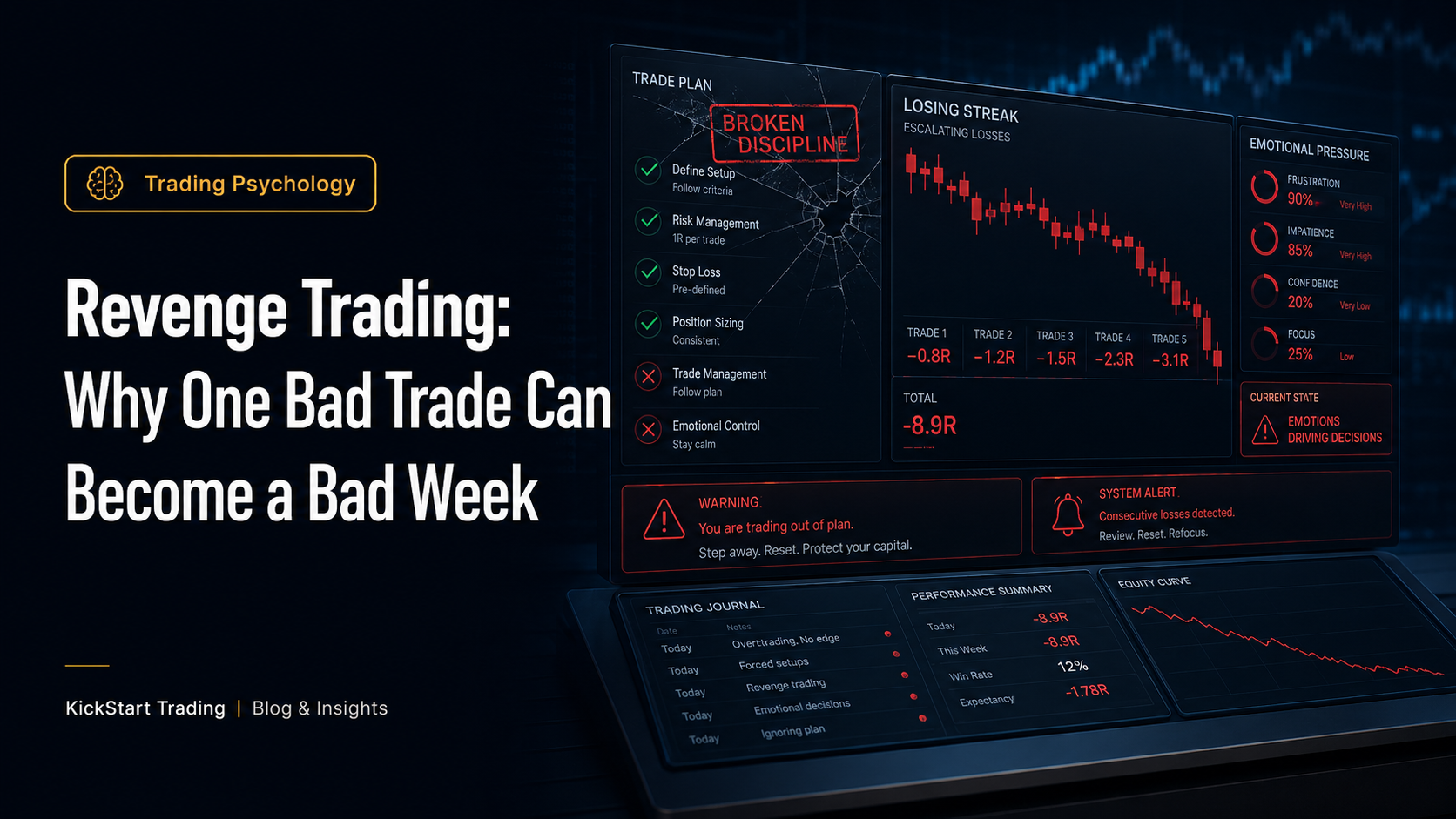
One losing trade should not destroy your account.
One bad entry should not ruin your week.
One mistake should not turn into a complete breakdown of discipline.
But for many traders, that is exactly what happens.
They take a loss.
They feel frustrated.
They want to make it back.
They enter again too quickly.
Then again.
Then again.
Before long, the problem is no longer the original trade.
The problem is the trader’s reaction to it.
That is revenge trading.
And it is one of the most destructive habits in trading.
What is revenge trading?
Revenge trading happens when a trader tries to recover losses emotionally instead of following a clear trading plan.
The trader is no longer making decisions based on strategy, market structure, risk management, or process.
They are reacting.
They want the money back.
They want to prove they were right.
They want to erase the frustration.
They want to end the day green.
That emotional urgency creates dangerous behaviour.
The trader may increase position size, take poor-quality setups, ignore stop losses, overtrade, or break rules they normally understand.
Revenge trading is not really about the market.
It is about the trader trying to repair how they feel.
Why revenge trading happens
Revenge trading usually begins with emotion.
A trader takes a loss and experiences frustration, embarrassment, anger, fear, or panic.
That emotional reaction can be intensified when:
- The trader expected the setup to work
- The market almost hit target before reversing
- The loss came after a winning streak
- The account is already in drawdown
- The trader is near a funded-account rule limit
- The trader is under financial pressure
- The trader feels they “need” a good trading day
The loss becomes personal.
Instead of seeing it as part of trading, the trader sees it as something that must be fixed immediately.
That is where the spiral begins.
The market does not owe you a recovery trade
One of the hardest lessons in trading is that the market does not owe you anything.
It does not owe you a win after a loss.
It does not owe you a perfect setup because you waited all day.
It does not owe you a payout because you worked hard.
It does not owe you an easy recovery because the last trade was frustrating.
The market is not aware of your emotions.
It is not trying to punish you.
It is not trying to reward you.
It is simply moving.
When a trader forgets that, they start fighting the market.
And traders who fight the market usually lose discipline quickly.
Revenge trading turns one loss into many
The original loss is often manageable.
The damage comes from what happens next.
A planned trade may lose 1%.
That is normal.
But if the trader reacts emotionally, that 1% loss can become 3%, 5%, 8%, or more.
Not because the strategy failed.
Because discipline failed.
This is what makes revenge trading so dangerous.
It turns normal trading variance into account damage.
It takes a manageable setback and turns it into a destructive session.
The trader did not lose because one trade failed.
They lost because they refused to stop.
Revenge trading and funded accounts
Revenge trading is especially dangerous in funded trading.
Funded accounts have defined rules.
Maximum drawdown.
Consistency rules.
News rules.
Holding rules.
A trader who revenge trades may violate those rules quickly.
The account does not care whether the trader was emotional.
It does not care whether the trader intended to recover.
It does not care whether the next trade looked “almost perfect.”
A rule breach is a rule breach.
That is why funded traders must take revenge trading seriously.
One emotional session can end the account.
If you are trading or preparing for a funded account, understanding daily loss limits is essential.
The signs of revenge trading
Revenge trading is not always obvious at first.
Sometimes it feels like determination.
Sometimes it feels like confidence.
Sometimes it feels like “I see another opportunity.”
But there are warning signs.
You may be revenge trading if:
- You enter immediately after a loss without proper analysis
- You increase risk to make the money back faster
- You take trades that do not match your plan
- You feel angry at the market
- You refuse to stop after multiple losses
- You move your stop because you do not want another loss
- You chase a move you originally missed
- You keep saying “just one more trade”
- You are focused on getting back to breakeven instead of executing well
When those signs appear, the trader needs to stop.
Not soon.
Immediately.
Revenge trading often starts with ego
A major cause of revenge trading is ego.
The trader does not want to accept being wrong.
They may have analysed the chart carefully. They may have felt confident. They may have told themselves the setup was perfect.
Then the market proves otherwise.
Instead of accepting the loss, the trader becomes defensive.
They want to prove the market wrong.
They want to prove themselves right.
But trading is not about being right.
It is about managing risk while making decisions under uncertainty.
A trader who cannot accept being wrong will struggle to survive.
Losses are not insults.
They are part of the business.
A loss is feedback, not a personal attack
A losing trade does not automatically mean the trader is bad.
It does not automatically mean the strategy is broken.
It does not automatically mean the market is unfair.
Sometimes a good trade loses.
Sometimes a valid setup fails.
Sometimes the market simply does not follow through.
A serious trader understands this.
They review the trade calmly and ask:
- Did I follow my plan?
- Was the setup valid?
- Was the risk appropriate?
- Was the stop logical?
- Did I manage the trade properly?
- Was this a normal loss or a mistake?
That kind of review is useful.
Emotional reaction is not.
Build a rule for what happens after a loss
One of the best ways to prevent revenge trading is to create a post-loss rule before the session starts.
For example:
- After one loss, pause for ten minutes
- After two losses, stop trading for the session
- After one mistake-based loss, stop immediately
- After reaching a personal daily stop, close the platform
- After emotional frustration appears, step away before taking another trade
The exact rule depends on the trader.
But the rule must exist before the loss happens.
If the trader waits until they are emotional to decide what to do, the decision is already compromised.
A post-loss rule protects the trader from themselves.
Use a personal daily stop
The official daily loss limit on a funded account should not be the trader’s normal stopping point.
It should be the emergency boundary.
A serious trader should usually have a personal daily stop before reaching the official limit.
For example, if the account allows a 5% daily loss, the trader may choose to stop at 2%.
That creates a buffer.
It also reduces the temptation to keep trading until the account is in danger.
Revenge trading thrives when there is no boundary.
A personal daily stop creates one.
Do not increase risk after a loss
Increasing risk after a loss is one of the clearest signs of emotional trading.
The trader wants to recover faster, so they increase position size.
That may work once or twice.
But long term, it is dangerous.
A trader who doubles risk after losing is no longer trading professionally.
They are trying to force the account back to where it was.
That behaviour can quickly turn a normal losing streak into a major drawdown.
A simple rule can help:
Never increase risk because of a loss.
If anything, losses should make the trader more careful, not more aggressive.
Step away before the spiral starts
The best time to stop revenge trading is before it fully begins.
Once the trader is deep in the spiral, it becomes harder to think clearly.
That is why early interruption matters.
If you feel frustration rising, step away.
If you start thinking about getting the money back, step away.
If you are staring at the chart looking for anything to trade, step away.
If you feel the urge to increase size, step away.
Walking away is not weakness.
It is control.
A trader who can stop themselves before doing damage is demonstrating discipline.
Review the loss properly
After a losing trade, review it.
But do not review it while angry.
Wait until you are calm enough to think clearly.
Then ask:
- Was the trade part of my plan?
- Did I enter for a valid reason?
- Was my stop placed correctly?
- Did I risk the right amount?
- Did I manage the trade according to plan?
- Did I exit properly?
- Was the loss normal or caused by a mistake?
- What should I do differently next time?
This turns the loss into data.
Without review, the trader may repeat the same mistake again and again.
With review, the trader can improve.
Separate process from outcome
A trade can lose even if the process was good.
A trade can win even if the process was poor.
This is one of the reasons trading is psychologically difficult.
If a trader judges everything only by outcome, they may punish themselves for good losses and reward themselves for bad decisions.
That creates confusion.
A serious trader reviews process first.
Did I follow the plan?
Did I manage risk?
Did I respect my rules?
Did I behave professionally?
If the answer is yes, a loss can be acceptable.
If the answer is no, even a winning trade may reveal a problem.
Revenge trading and overtrading
Revenge trading often leads directly into overtrading.
The trader keeps searching for another setup because they want to recover.
They lower their standards.
They take trades they would normally skip.
They confuse activity with progress.
But more trades do not automatically mean better trading.
In many cases, more trades simply create more opportunities to make emotional mistakes.
Sometimes the best trade after a loss is no trade.
That is difficult for impatient traders to accept.
But it is often exactly what the account needs.
How to recover from a revenge trading episode
If you have revenge traded, the first step is honesty.
Do not pretend it was just bad luck.
Do not blame the market.
Do not immediately look for a new strategy.
First, admit what happened.
Then stop trading.
Review the session.
Identify the trigger.
Write down the moment discipline broke.
Ask what rule would have prevented the damage.
Then create that rule before trading again.
The goal is not to shame yourself.
The goal is to learn.
Every trader makes mistakes.
The difference is whether the mistake becomes a pattern.
Build a reset routine
A reset routine can help prevent one bad session from becoming a bad week.
After a difficult trading day, the trader may need to reset physically and mentally.
That might include:
- Closing the platform
- Taking a walk
- Journaling the session
- Reviewing screenshots
- Reducing risk the next day
- Returning to demo temporarily
- Studying the mistake
- Waiting for a clean setup before trading again
A reset routine gives the trader structure when emotions are high.
It prevents the next session from carrying the emotional weight of the previous one.
Do not let one bad trade define you
One bad trade does not define you.
One losing day does not define you.
Even one revenge trading episode does not define you if you learn from it and change the behaviour.
But repeated refusal to address the pattern will define your trading results.
That is the hard truth.
A trader cannot build consistency while repeatedly losing control after setbacks.
Revenge trading must be treated seriously.
Not casually.
Not as something that “just happens.”
It is a behaviour that needs rules, awareness, and discipline.
Final thoughts
Revenge trading is one of the fastest ways to damage an account.
It turns normal losses into emotional spirals.
It breaks risk plans.
It causes overtrading.
It pushes traders toward rule violations.
And in funded trading, it can end an account quickly.
The solution is not to avoid losses entirely.
That is impossible.
The solution is to control your response to losses.
Create post-loss rules.
Respect daily stops.
Do not increase risk emotionally.
Step away when frustration appears.
Review the trade when calm.
Protect the account.
A serious trader does not need to win every trade.
A serious trader needs to stay disciplined when a trade loses.
That is where growth begins.
To your health, wealth, and happiness, always,
Chris