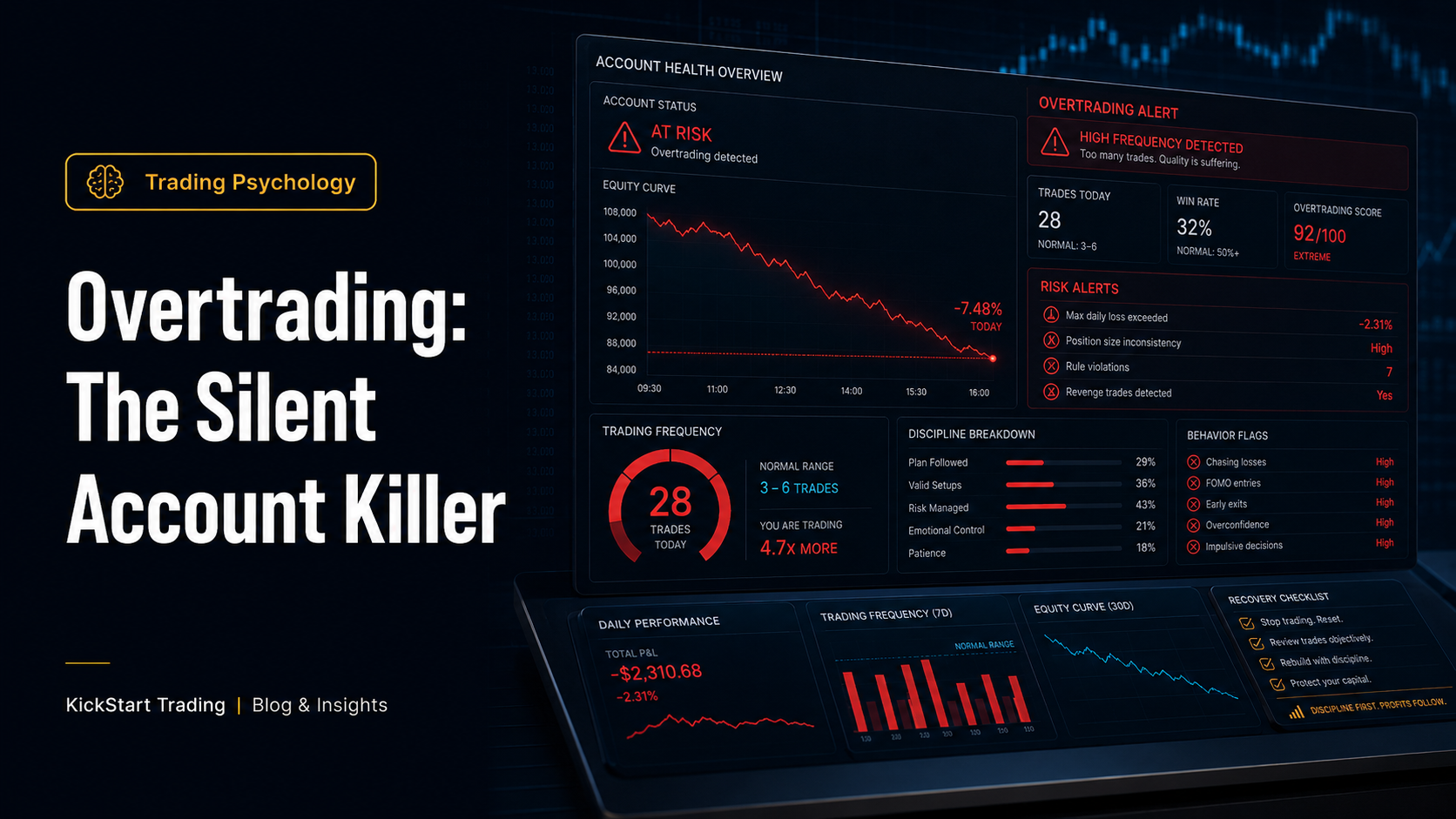
Overtrading does not always look dramatic at first.
It often starts quietly.
One extra trade.
Then another.
Then one more after a loss.
Then one more because the market is moving.
Then one more because the trader feels close to recovering the day.
Before long, the problem is no longer the market.
The problem is behaviour.
Overtrading is one of the most common ways traders damage their accounts, lose discipline, and fail funded-account challenges.
It is also one of the easiest problems to justify in the moment.
That is what makes it dangerous.
What is overtrading?
Overtrading means taking too many trades, taking trades outside the plan, or continuing to trade when the quality of decision-making has dropped.
It is not only about the number of trades.
A trader could take five valid trades and not be overtrading.
Another trader could take two poor emotional trades and already be overtrading.
The real issue is not quantity alone.
The issue is whether the trades are planned, justified, controlled, and aligned with the trader’s strategy.
Overtrading begins when execution stops being disciplined.
Overtrading often hides behind opportunity
Many traders convince themselves they are simply taking opportunities.
The market is moving.
A setup might form.
Price is near a level.
There is momentum.
Another candle appears.
The trader tells themselves:
This could work.
That phrase can be dangerous.
A serious trade idea should be stronger than “this could work.”
It should match the plan.
It should have a clear reason for entry.
It should have a defined invalidation point.
It should have acceptable risk.
It should fit the trader’s rules.
If those things are missing, the trader may not be trading opportunity.
They may be trading emotion.
Why traders overtrade
Traders overtrade for many reasons.
Some overtrade because they are impatient.
Some overtrade because they are bored.
Some overtrade because they want to recover losses.
Some overtrade because they feel confident after wins.
Some overtrade because they are afraid of missing out.
Some overtrade because they do not have a clear trading plan.
Some overtrade because they are trying to force progress.
The reason may change from trader to trader, but the result is often similar.
More trades.
Lower quality.
Higher emotional pressure.
More mistakes.
Greater damage to the account.
Boredom is a major trigger
Boredom is one of the most underestimated causes of overtrading.
A trader opens the chart expecting action.
But nothing clean is happening.
No valid setup.
No clear structure.
No proper entry.
Instead of waiting, they start looking harder.
They zoom in.
They change timeframe.
They mark new levels.
They convince themselves a weak setup is good enough.
This is how boredom turns into risk.
The market does not owe the trader entertainment.
If there is no setup, the professional decision is to wait.
Revenge trading often becomes overtrading
Revenge trading and overtrading are closely connected.
After a loss, the trader may feel the need to win the money back.
They take another trade quickly.
If that one loses, pressure increases.
Now the trader wants to recover two losses.
They take another trade.
Then another.
At this point, the trader is no longer executing a plan.
They are reacting emotionally.
Overtrading becomes the vehicle for revenge trading.
This can destroy a day, a week, or a funded account very quickly.
Winning can also cause overtrading
Many traders understand the danger of trading after losses.
Fewer understand the danger of trading after wins.
A winning trade can create excitement.
A winning streak can create overconfidence.
The trader begins to feel unusually sharp.
They may think:
I am seeing the market clearly today.
That feeling can lead to unnecessary trades.
The trader gives back profit.
Then frustration appears.
Then they trade again to reclaim the good day.
Suddenly, a profitable session turns into a damaging session.
Overtrading does not only come from pain.
It can also come from excitement.
Overtrading lowers setup quality
The more a trader forces trades, the lower the average quality usually becomes.
The first trade may be valid.
The second may be acceptable.
The third may be questionable.
The fourth may be emotional.
The fifth may be completely outside the plan.
This decline can happen quickly.
The trader may not notice it in real time because emotion clouds judgement.
That is why rules matter.
A trader should not rely only on how they feel during the session.
They need boundaries that protect them when judgement becomes weaker.
Overtrading increases execution mistakes
Overtrading does not only create more exposure.
It creates more mistakes.
A trader who overtrades may:
- Enter too early
- Chase price
- Move stops
- Ignore invalidation
- Take poor risk-to-reward
- Increase position size
- Trade during news
- Trade tired
- Skip journaling
- Ignore the daily loss limit
- Break the trading plan
Mistakes compound.
One poor decision makes the next poor decision easier.
That is why overtrading can spiral.
More trades do not mean more progress
Many traders confuse activity with progress.
They believe that more trades means more experience.
Sometimes that is true in a controlled practice environment.
But in live trading, more trades can simply mean more damage.
Progress does not come from taking random trades.
Progress comes from executing a defined process, reviewing decisions, learning from mistakes, and improving discipline over time.
One high-quality trade can be more valuable than ten impulsive trades.
The goal is not to trade more.
The goal is to trade better.
Overtrading and funded accounts
Overtrading is especially dangerous in funded accounts.
Funded accounts usually have strict rules.
Daily loss limits.
Maximum drawdown.
Consistency expectations.
News rules.
Holding rules.
Position-size controls.
A trader who overtrades can run into these limits quickly.
Even if the strategy has potential, poor trade frequency can create unnecessary drawdown.
Funded accounts reward controlled execution.
They do not reward emotional volume.
A trader trying to force a payout may end up losing the account before the real opportunity develops.
Daily loss limits exist for a reason
Daily loss limits are often frustrating to traders.
But they exist to prevent exactly this kind of behaviour.
A trader having an emotional day needs a hard boundary.
Without one, they may continue trading until the damage becomes serious.
The daily loss limit forces the trader to stop before the account is destroyed.
But a serious trader should not wait for the platform’s rule to stop them.
They should have a personal daily stop before the official limit is reached.
That is professional risk control.
Set a maximum number of trades
One simple way to reduce overtrading is to set a maximum number of trades per day.
For example:
- Maximum three trades per day
- Maximum two full-risk losses per day
- Maximum one trade per session
- Stop after one emotional mistake
- Stop after reaching a daily profit target
The exact number depends on the strategy.
A scalper may naturally take more trades than a swing trader.
But every trader should know when enough is enough.
Unlimited trading creates unlimited opportunity for emotional damage.
Define what a valid setup looks like
Overtrading often happens when the setup criteria are unclear.
If the rules are vague, almost anything can become a trade.
The trader can always find a reason.
A candle pattern.
A level.
Momentum.
A feeling.
A possible breakout.
A possible reversal.
This is why the trading plan must define what a valid setup looks like.
The clearer the setup, the easier it becomes to reject poor trades.
A good plan does not only tell the trader when to trade.
It tells them when not to trade.
Use a pre-trade checklist
A pre-trade checklist can help stop overtrading.
Before entering, the trader can ask:
- Does this match my strategy?
- Is the setup clear?
- Is the market condition acceptable?
- Do I know my invalidation point?
- Is the stop loss logical?
- Is the risk-to-reward acceptable?
- Is my position size correct?
- Am I close to my daily loss limit?
- Am I trading emotionally?
- Would I take this trade if I had not just won or lost?
If the answer is weak, the trader should pause.
The checklist creates friction between emotion and execution.
That friction can protect the account.
Stop after emotional mistakes
Every trader makes mistakes.
The key is not letting one mistake become ten.
If a trader breaks a rule, moves a stop, revenge trades, or enters impulsively, that should trigger a pause.
Sometimes the best rule is simple:
If I make an emotional mistake, I stop trading for the day.
That may feel extreme.
But it can save the account.
A trader who continues after emotional mistakes is often not in the right state to make high-quality decisions.
Stop after reaching the daily goal
Some traders need rules after winning, not just after losing.
If the trader reaches a realistic daily target, they may decide to stop.
This prevents giving back profits because of excitement or greed.
A profitable day does not need to become a perfect day.
The goal is consistency.
A trader who repeatedly gives back good days may have a discipline problem, not a strategy problem.
Stopping while ahead can be an act of professionalism.
Journal overtrading patterns
A trading journal should track overtrading.
The trader should record:
- Number of trades taken
- Which trades followed the plan
- Which trades were emotional
- Time of day mistakes happened
- Emotional state before each trade
- Whether losses triggered more trades
- Whether wins triggered more trades
- Whether boredom was involved
- Whether the trader respected stopping rules
Over time, patterns become clear.
Maybe overtrading happens after the first loss.
Maybe it happens near the end of the session.
Maybe it happens after a strong win.
Maybe it happens when the trader is tired.
The journal reveals what memory hides.
Reduce risk when discipline weakens
If a trader notices their discipline weakening, they should reduce risk or stop trading.
There is no shame in stepping back.
The market will still be there tomorrow.
A trader who protects the account during poor emotional conditions is making a professional decision.
Many traders think discipline means pushing through.
Sometimes discipline means stopping.
That distinction matters.
Overtrading is often a structure problem
Overtrading is not always a willpower problem.
Sometimes it is a structure problem.
If the trader has no written plan, no maximum trades, no daily stop, no setup checklist, no journal, and no review process, overtrading becomes much more likely.
The solution is not only to “try harder.”
The solution is to build better structure.
Rules reduce emotional decision-making.
Structure protects the trader from themselves.
The trader must accept missed moves
A trader who cannot accept missed moves is likely to overtrade.
Markets will move without you.
That is normal.
There will be trades you miss.
There will be setups you see too late.
There will be moves that run without giving entry.
That is part of trading.
A serious trader does not chase every missed move.
They accept that protecting discipline matters more than catching everything.
Missing a move is not failure.
Breaking the plan is the greater danger.
The KickStart approach
At KickStart Trading, we believe traders need structure before they need more trades.
More screen time alone does not create discipline.
More trades alone do not create skill.
A trader needs a plan, risk rules, a journal, a process, and the humility to stop when the quality of decision-making drops.
Overtrading is not solved by motivation.
It is solved by structure.
That structure helps traders protect capital, think clearly, and build consistency over time.
Final thoughts
Overtrading is a silent account killer.
It often starts small.
One extra trade.
One emotional decision.
One attempt to recover.
One forced setup.
But small rule breaks can become serious damage if they are repeated.
The trader’s job is not to trade every movement.
The trader’s job is to wait for valid setups, manage risk, protect the account, and follow the plan.
More trades do not automatically mean more progress.
Better decisions create progress.
If you want to reduce overtrading, build rules.
Set limits.
Use a checklist.
Journal honestly.
Stop after emotional mistakes.
Accept missed moves.
Protect the account.
That is how serious traders survive long enough to improve.
To your health, wealth, and happiness, always,
Chris