Choosing a funded account size can be exciting.
A trader sees a large account and immediately starts imagining the possibilities.
A bigger account.
A bigger payout.
A bigger opportunity.
But bigger is not always better.
In funded trading, the right account size is not simply the largest one you can afford. It is the account size you can manage responsibly, trade consistently, and handle psychologically.
Many traders choose account size based on ambition.
Serious traders choose account size based on readiness.
That difference matters.
Account size changes psychology
A trader may think they will behave the same way on every account size.
But that is not always true.
The percentage risk may be identical, but the monetary value can feel very different.
Risking 1% on a $5,000 account is not the same emotional experience as risking 1% on a $100,000 account.
The maths may be the same.
The pressure may not be.
Larger accounts can make normal losses feel more serious. They can make traders hesitate, overmanage, close too early, or become afraid of taking valid setups.
They can also make traders greedy.
A trader might see the potential payout and start forcing trades, increasing risk, or chasing the profit target too aggressively.
That is why account size is not only a financial decision.
It is a psychological decision.
Bigger accounts can create bigger mistakes
A larger funded account can be powerful in the right hands.
But it can also magnify poor habits.
If a trader already struggles with discipline, increasing account size will not fix that. It may make the problem worse.
A trader who overtrades on a small account may overtrade more aggressively on a larger one.
A trader who revenge trades after a small loss may become even more emotional when the loss number is larger.
A trader who breaks rules under light pressure may struggle even more when they feel there is a major opportunity on the line.
This is why traders should not choose account size based only on what they want.
They should choose based on what they can actually handle.
Start with your real trading behaviour
Before choosing a funded account size, look honestly at your current trading behaviour.
Ask yourself:
- Do I follow my trading plan consistently?
- Do I respect stop losses?
- Do I stop after a bad day?
- Do I understand drawdown?
- Do I revenge trade?
- Do I overtrade when bored?
- Do I increase risk after losses?
- Do I get emotional when money is involved?
- Do I review my trades properly?
- Do I know my average losing streak?
These questions are more important than the account size itself.
A trader who cannot answer them honestly may not be ready for a large account.
That does not mean they should give up.
It means they should choose an account size that supports development rather than exposes weakness too quickly.
Understand the drawdown rules first
Account size cannot be judged properly without understanding drawdown.
A $100,000 account with a strict drawdown rule may not give the trader as much breathing room as they assume.
Likewise, a smaller account with clearer rules may actually be easier to manage.
Before buying any funded account, understand:
- The maximum loss limit
- The daily loss limit
- Whether drawdown is static or trailing
- Whether drawdown is based on equity or balance
- Whether commissions and fees count toward limits
- Whether open trades affect the calculation
- Whether the drawdown locks at a certain level
This is critical.
The account size is only one part of the decision.
The rule structure determines how that account actually feels.
If you have not already done so, read our guide on static vs trailing drawdown before choosing an account size.
Think in terms of risk per trade
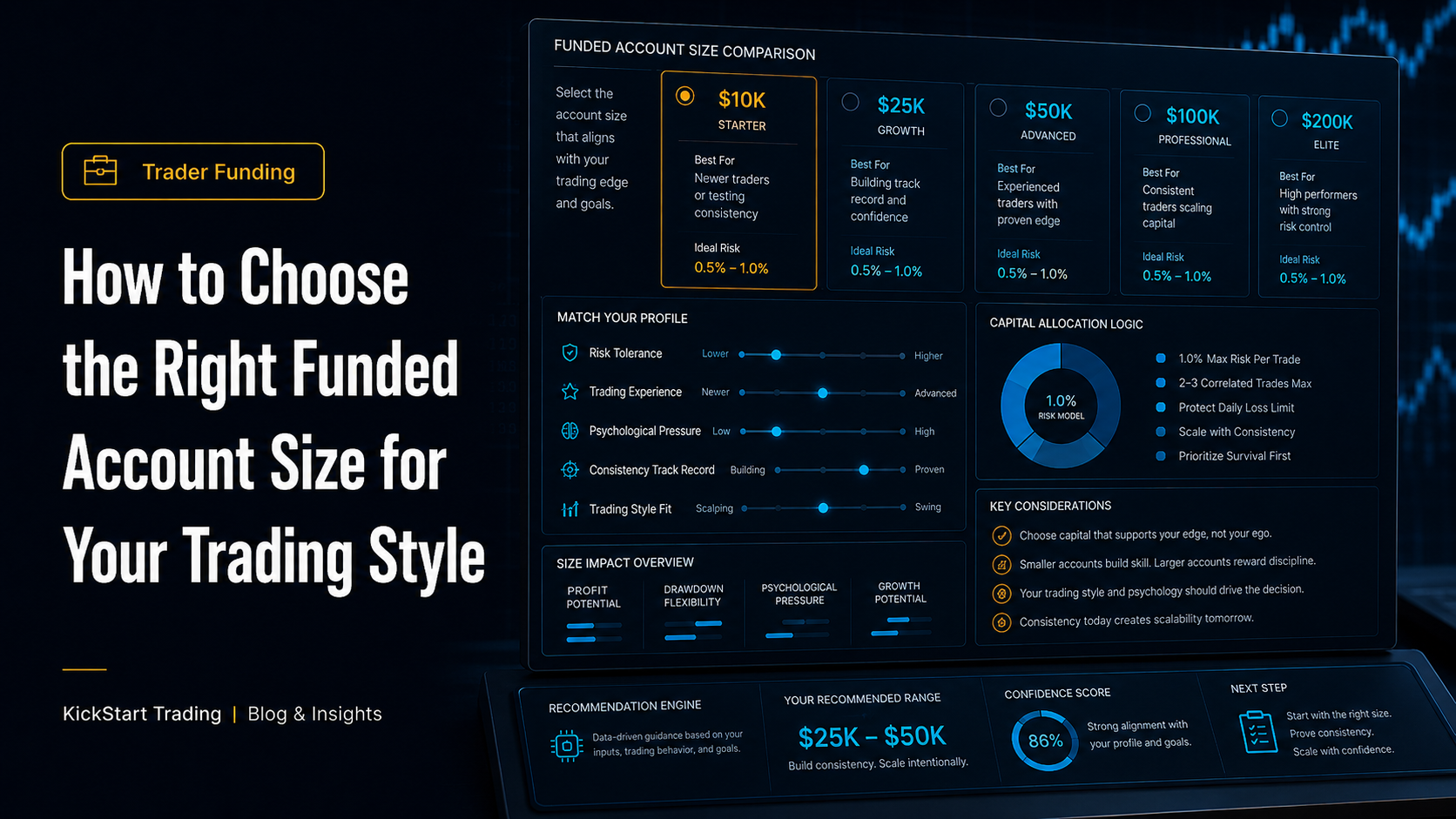
One of the best ways to evaluate account size is to think in terms of risk per trade.
For example, if a trader risks 1% per trade:
- On a $10,000 account, that is $100
- On a $50,000 account, that is $500
- On a $100,000 account, that is $1,000
- On a $250,000 account, that is $2,500
The percentage may be the same, but the emotional weight can feel very different.
A trader should ask:
Can I take a normal loss at this size without changing my behaviour?
If the answer is no, the account may be too large for the trader’s current psychological stage.
The goal is not to choose the biggest account possible.
The goal is to choose the account size you can trade properly.
Match the account to your strategy
Different strategies need different conditions.
A scalper may take more trades and use tighter stops.
A swing trader may take fewer trades and need more room for stops.
A trader focused on gold may experience different volatility from a trader focused on major forex pairs.
A futures trader may think in contracts rather than lots.
Before choosing an account size, the trader should understand how their strategy behaves.
Questions to ask include:
- How many trades do I normally take per week?
- What is my average stop size?
- What is my typical risk-to-reward profile?
- How often do I experience losing streaks?
- How much drawdown is normal for my strategy?
- Does my strategy work within the account rules?
- Do I need to hold overnight or over the weekend?
- Does the account allow my trading style?
The right account size is not separate from the strategy.
It should fit the strategy.
Small accounts are not failure
Many traders feel embarrassed to start with a smaller funded account.
They should not.
A smaller account can be a smart decision.
It allows the trader to experience the rules, pressure, platform, execution, and psychology without immediately taking on the emotional weight of a much larger account.
A trader who can manage a smaller account professionally is building the foundation for larger opportunities later.
There is nothing weak about starting sensibly.
In fact, it often shows maturity.
The trader who chooses the right account size for their actual stage is usually thinking more professionally than the trader who blindly buys the biggest account they can afford.
Large accounts require maturity
Large funded accounts can be attractive.
They can also be demanding.
A trader managing a larger account must be able to handle:
- Larger monetary swings
- Stronger emotional pressure
- More temptation to overtrade
- Greater fear of losing the opportunity
- More discipline around daily loss limits
- More responsibility around risk management
This does not mean large accounts are bad.
It means they should be treated seriously.
If a trader is ready, a larger account can be a meaningful opportunity.
If a trader is not ready, it can become an expensive lesson.
Do not choose based only on payout potential
Payout potential is one of the main reasons traders are drawn to larger accounts.
That is understandable.
But payout potential should not be the only factor.
A trader who focuses only on the payout may ignore the process required to reach it.
They may become fixated on how much they could make instead of how they need to trade.
That mindset is dangerous.
The first job is not to imagine the payout.
The first job is to protect the account.
A trader who cannot protect the account will never reach consistent payouts anyway.
Consider your current financial pressure
This is an uncomfortable but important point.
Traders under financial pressure are often more likely to make emotional decisions.
If a trader needs the funded account to solve immediate financial problems, they may trade from desperation rather than discipline.
That can affect account-size choice.
A larger account may feel like a bigger solution, but it may also create bigger pressure.
A trader should be honest about their situation.
If the account feels like a last chance, the trader may be more likely to force trades, chase targets, and break rules.
Funding should be approached as a professional opportunity.
Not a panic button.
Choose the account you can trade calmly
A good account size should allow the trader to trade calmly.
That does not mean there will be no pressure.
There is always pressure in trading.
But the account should not be so large that every normal loss feels emotionally overwhelming.
A useful question is:
Can I take three normal losses on this account and still follow my plan?
If the answer is yes, the account may be realistic.
If the answer is no, the trader may need a smaller size, reduced risk, or more preparation before buying.
The right account size should challenge the trader without destroying their discipline.
Scaling is better than rushing
Many traders want to start big immediately.
But scaling over time can be a smarter approach.
A trader can begin with a manageable account size, prove consistency, understand the rules, build confidence, and then move into larger opportunities later.
This creates a healthier development path.
Instead of trying to force a major result immediately, the trader builds competence step by step.
That is more aligned with long-term professional behaviour.
Trading is not supposed to be a one-shot gamble.
It is supposed to be a skill-building process.
Account size and funded-account route
The right account size may also depend on the funding route.
A trader choosing 1-Step Funding may want to think carefully about the pressure of a more direct route.
A trader choosing 2-Step Funding may have more time to settle into the process, but still needs to manage risk across both phases.
A trader choosing Instant Funding should be especially careful because the pressure begins immediately.
A trader choosing Futures Funding needs to think in terms of contracts, session volatility, and intraday risk.
The account size should match both the trader and the route.
Not just the trader’s ambition.
A practical account-size checklist
Before choosing an account size, ask:
- Have I traded this size before?
- Can I handle normal losses at this size?
- Do I understand the drawdown rules?
- Does my strategy fit the account structure?
- Can I respect the daily loss limit?
- Am I choosing this account because I am ready?
- Or am I choosing it because I want a bigger payout?
- Would a smaller account help me trade better?
- Do I have a plan for scaling later?
- Can I trade this account without desperation?
If the answers are unclear, slow down.
Choosing the wrong account size can create avoidable pressure before the first trade is even placed.
The KickStart approach
At KickStart Trading, we believe funding should be approached with structure.
That means helping traders think beyond account size.
The biggest account is not always the best account.
The best account is the one that gives the trader a realistic chance to follow their process, respect the rules, manage drawdown, and build consistency.
That is why education, risk management, psychology, and funding need to work together.
A trader should not simply ask:
How much can I make?
They should ask:
What account can I manage professionally?
That question leads to better decisions.
Final thoughts
Choosing the right funded account size is about more than ambition.
It is about self-awareness.
A trader needs to understand their strategy, psychology, risk tolerance, drawdown limits, and current level of discipline.
Bigger accounts can create bigger opportunities.
But they can also create bigger mistakes.
The goal is not to impress anyone with the size of the account.
The goal is to choose a structure you can trade responsibly.
Start where you can perform well.
Build consistency.
Respect risk.
Then scale with discipline.
That is how serious traders approach funding.
To your health, wealth, and happiness, always,
Chris