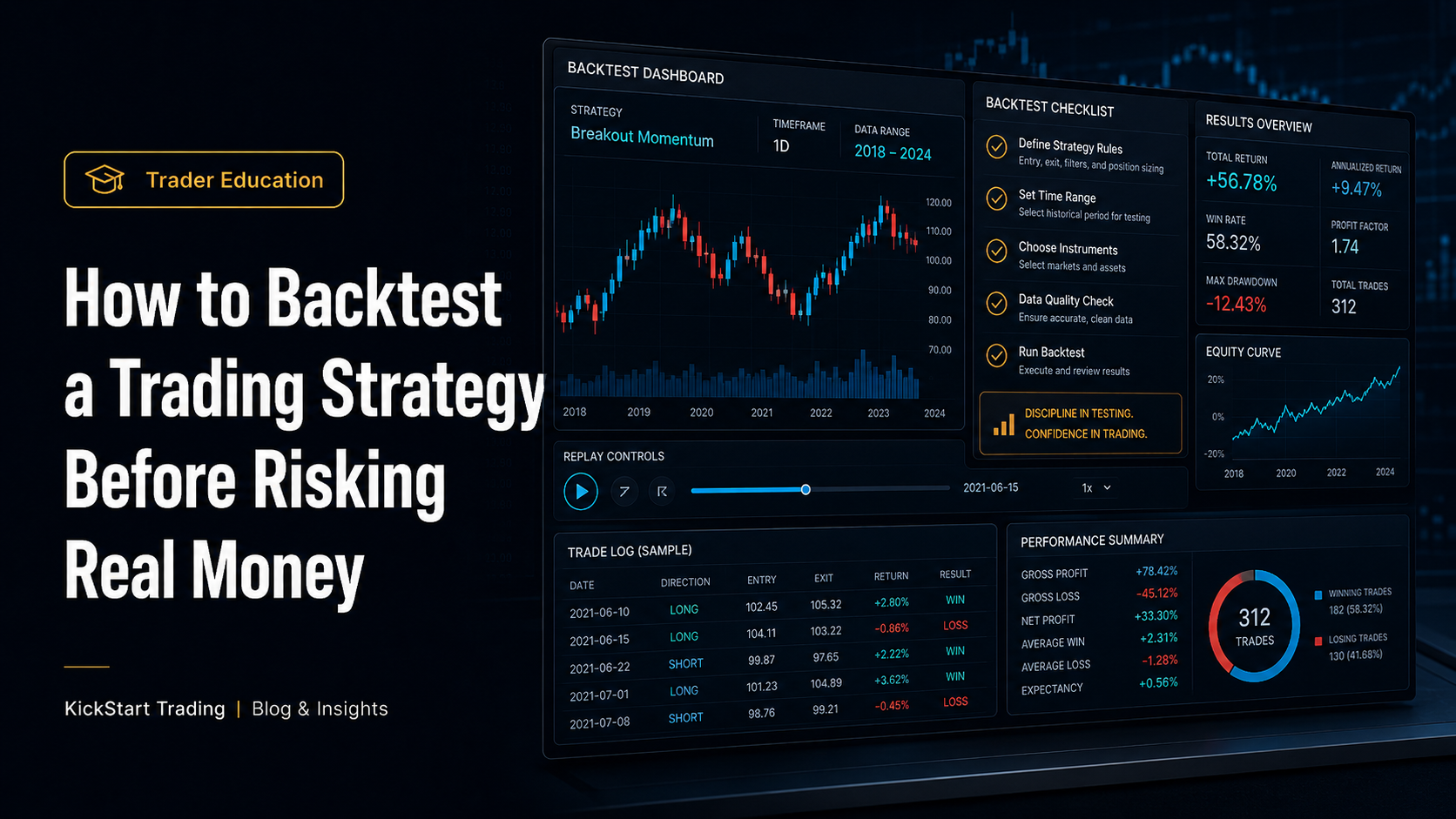
A trader should not risk real money on a strategy they have never tested.
That sounds obvious.
But many traders do exactly that.
They watch a video, learn a setup, see a few examples, feel excited, and then take the strategy straight into live markets.
That is dangerous.
A trading strategy needs to be studied before it is trusted.
Backtesting is one of the best ways to begin that process.
It does not guarantee future results.
Nothing in trading does.
But it can help traders understand how a strategy behaves, where it performs well, where it struggles, and whether it fits their personality, schedule, and risk tolerance.
What is backtesting?
Backtesting is the process of studying how a trading strategy would have performed using historical market data.
The trader goes back through old charts and applies the strategy rules as if they were trading live.
They record entries, stops, targets, wins, losses, risk-to-reward, market conditions, and mistakes.
The goal is not to prove that a strategy is perfect.
No strategy is perfect.
The goal is to gather evidence.
A trader wants to know whether the strategy has shown enough historical potential to justify further testing.
Backtesting helps turn trading ideas into measurable data.
Backtesting is not prediction
Backtesting does not predict the future. The CFTC specifically warns that hypothetical results have inherent limitations because they do not represent actual execution and may fail to capture liquidity, slippage, spreads, costs, or the practical difficulty of absorbing losses. That is worth reading alongside any historical test: CFTC: Commodity Trading Systems Sold on the Internet.
A strategy that performed well in the past may not perform the same way in the future.
Market conditions change.
Volatility changes.
Spreads change.
Execution changes.
Trader behaviour changes.
That is why backtesting should not be treated as certainty.
It should be treated as research.
The trader is asking:
Has this strategy shown evidence of working under certain conditions?
That evidence can help the trader decide whether the strategy deserves more study.
But it should not create blind confidence.
Why backtesting matters
Backtesting matters because it slows the trader down.
Instead of rushing into live trades, the trader studies the strategy first.
That creates discipline before money is involved.
Backtesting can help traders understand:
- Whether the setup appears often enough
- Which market conditions suit the strategy
- Which conditions should be avoided
- Typical win rate
- Typical losing streaks
- Average risk-to-reward
- Best sessions or times of day
- Whether the strategy fits funded-account rules
- Whether the trader can realistically execute it
This kind of information is valuable.
Without it, the trader is relying mostly on hope.
Start with clear rules
A strategy cannot be backtested properly if the rules are unclear.
Before backtesting, the trader should define:
- Market traded
- Timeframes used
- Entry criteria
- Stop-loss rules
- Target rules
- Risk-to-reward minimum
- Confirmation requirements
- Sessions traded
- Conditions to avoid
- News rules
- Trade management rules
The clearer the rules, the more useful the backtest.
If the strategy is vague, the trader may accidentally change the rules from trade to trade.
That makes the results unreliable.
A backtest should measure a repeatable process.
Not random interpretation.
Choose the market carefully
The trader should backtest the market they actually intend to trade.
A strategy tested on EUR/USD may not behave the same way on gold.
A strategy tested on gold may not behave the same way on indices.
A strategy tested on one timeframe may not behave the same way on another.
Each market has its own personality, volatility, liquidity, and rhythm.
The trader should choose the market deliberately.
If the goal is to trade XAUUSD, then backtest XAUUSD.
If the goal is to trade major forex pairs, test those pairs.
Do not assume results transfer automatically across markets.
Use enough historical data
A backtest needs enough examples to be useful.
Testing five trades is not enough.
Testing ten trades is usually not enough either.
A trader should aim for a meaningful sample size.
The exact number depends on the strategy and timeframe, but more data usually gives a clearer picture.
For many traders, a useful starting target may be at least 50 to 100 trades.
More is better if the rules are applied consistently.
A small sample can be misleading.
A few lucky winners may make a weak strategy look strong.
A few unlucky losses may make a good strategy look poor.
The larger the sample, the more meaningful the data becomes.
Avoid cherry-picking
Cherry-picking is one of the biggest backtesting mistakes.
This happens when a trader only selects the cleanest examples and ignores the messy ones.
They find perfect setups.
Perfect reactions.
Perfect targets.
Perfect screenshots.
Then they convince themselves the strategy is better than it really is.
That is not proper backtesting.
A real backtest includes every trade that meets the rules.
Winners.
Losers.
Break-even trades.
Messy trades.
Uncomfortable trades.
If the setup qualifies under the rules, record it.
The point is not to make the strategy look good.
The point is to find the truth.
Record every trade
A backtest should be recorded clearly.
The trader should track:
- Date
- Market
- Timeframe
- Direction
- Entry
- Stop loss
- Target
- Result
- R-multiple
- Session
- Setup type
- Notes
- Screenshot
This creates a proper record.
Without written data, the trader may rely on memory, and memory is unreliable.
A structured backtest helps the trader review results objectively.
It also makes it easier to compare different strategies, markets, or timeframes later.
Use screenshots
Screenshots are extremely useful during backtesting.
They help the trader review the quality of setups visually.
A screenshot can show:
- Market structure
- Entry location
- Stop placement
- Target area
- Higher-timeframe context
- Whether the setup was clean
- Whether the trade was forced
- What the trader may have missed
Screenshots also help build pattern recognition.
Over time, the trader begins to see what the best setups have in common.
That is one of the most valuable parts of the process.
Measure results in R
Backtesting should not only measure money.
It should measure R.
R refers to the amount risked on the trade.
A +2R trade made twice the amount risked.
A -1R trade lost the planned risk.
Using R helps the trader compare performance across different account sizes and position sizes.
It keeps the focus on risk and reward rather than emotional money amounts.
For example, a strategy that averages +0.4R per trade may be worth studying further.
A strategy that produces frequent -1R losses with occasional small winners may need improvement.
R-multiple tracking makes the strategy easier to evaluate.
Track win rate and average reward
Win rate matters, but it does not tell the full story.
A strategy with a high win rate can still lose money if the losses are much larger than the wins.
A strategy with a lower win rate can still perform well if the winners are significantly larger than the losers.
That is why traders should track:
- Win rate
- Average win
- Average loss
- Average R
- Largest winning trade
- Largest losing trade
- Longest losing streak
- Longest winning streak
- Overall expectancy
These numbers help the trader understand the real behaviour of the strategy.
Pay attention to losing streaks
Losing streaks are important.
A trader may like a strategy until they realise it can lose five, six, or seven trades in a row.
That does not automatically mean the strategy is bad.
But the trader needs to know whether they can handle that emotionally and financially.
A funded trader also needs to know whether the strategy’s losing streaks fit within the account’s drawdown and daily loss rules.
If a normal losing streak would threaten the account, the risk per trade may need to be reduced.
Backtesting helps reveal these risks before real money is involved.
Test different conditions
A strategy may work well in some conditions and poorly in others.
For example, it may perform better:
- In trending markets
- During London or New York session
- After pullbacks
- Near higher-timeframe levels
- When volatility is moderate
- When no major news is nearby
It may perform worse:
- In choppy markets
- During low-liquidity periods
- During major news
- When price is extended
- Against higher-timeframe structure
- Inside messy ranges
This information is extremely useful.
A trader does not only need to know whether the strategy works.
They need to know when it works best.
Backtesting helps build patience
Backtesting can teach patience.
When traders review historical charts, they often realise that the best setups do not appear constantly.
There may be long periods where nothing clean happens.
This is valuable.
It shows the trader that waiting is part of the strategy.
Many traders lose money because they expect opportunity every time they open the chart.
Backtesting helps correct that expectation.
The trader learns what a valid setup looks like, but also what a non-setup looks like.
Both are important.
Backtesting can reveal personality fit
A strategy may look good on paper but still be wrong for the trader.
For example, a strategy may require holding trades for several days, but the trader becomes anxious holding overnight.
Another strategy may require fast entries on lower timeframes, but the trader has a busy schedule and cannot monitor charts closely.
Another may have a lower win rate, but the trader struggles emotionally with frequent losses.
Backtesting can help identify whether the strategy fits the trader’s personality.
A strategy does not only need theoretical potential.
It needs to be executable by the person trading it.
Do not change the rules mid-test
A common mistake is changing the strategy rules during the backtest.
The trader sees a losing trade and adjusts the rule to avoid it.
Then they see another loss and adjust again.
Before long, the backtest is no longer testing one strategy.
It is testing hindsight.
That makes the results unreliable.
Rules can be improved later.
But during a specific test, the rules should stay consistent.
Finish the sample.
Review the results.
Then decide whether a new version should be tested separately.
Be careful with hindsight bias
Hindsight bias is the tendency to believe something was obvious after it has already happened.
In backtesting, this can be dangerous.
Once the trader sees what price did, they may convince themselves they would have entered perfectly, exited perfectly, and avoided every mistake.
Live trading is not that clean.
When backtesting, the trader should try to simulate real decision-making as much as possible.
Use bar replay if available.
Move candle by candle.
Do not jump ahead to see the outcome before making the decision.
The more realistic the process, the more useful the test.
Include trading costs
Trading costs matter.
Spread, commission, slippage, swaps, and platform conditions can affect results.
A strategy that looks profitable before costs may be weaker after costs.
This is especially important for short-term traders.
If the strategy relies on small targets, trading costs can make a major difference.
Backtesting should account for realistic execution where possible.
Do not assume perfect fills.
Do not ignore spread.
Do not create results that could not realistically be achieved.
Backtesting is only the first step
Backtesting is important, but it is not the final test.
After backtesting, a trader should usually forward test the strategy.
Forward testing means applying the strategy in real time, either on demo, simulation, or very small live risk.
This is where the trader experiences decision-making without knowing the outcome in advance.
Forward testing reveals things backtesting cannot.
It shows how the trader handles waiting, hesitation, fear, boredom, and execution pressure.
A strategy should move from backtesting to forward testing before serious capital is risked.
Build a trading plan from the results
A good backtest should help build the trading plan.
The trader can use the data to define:
- Best markets
- Best sessions
- Valid setups
- Conditions to avoid
- Risk per trade
- Maximum trades per day
- Stop-loss rules
- Target rules
- Expected losing streaks
- Review process
- Funded-account suitability
This turns research into structure.
The goal is not just to know that a strategy worked historically.
The goal is to build a plan around that information.
Backtesting and funded accounts
Backtesting is especially useful before buying a funded account.
A trader should know whether their strategy fits the account rules.
Ask:
- Can the strategy reach the profit target realistically?
- Does the strategy fit the daily loss limit?
- Can it survive the maximum drawdown?
- Does it require holding trades over news or weekends?
- Does it produce long losing streaks?
- Does it rely on large position sizes?
- Does it work within the chosen market and session?
If the strategy does not fit the account structure, the trader may struggle even if the strategy has potential.
The funding route should match the trading approach.
Avoid testing only perfect market periods
Another common mistake is testing only ideal market periods.
For example, a trader might test a trend-following strategy during a strong trending market and get excellent results.
But what happens when the market ranges?
What happens when volatility changes?
What happens during news-heavy periods?
What happens when the market becomes choppy?
A useful backtest should include different conditions.
That gives a more honest view of the strategy.
A strategy does not need to work everywhere.
But the trader needs to know where it does not work.
Review mistakes without emotion
Backtesting can reveal weaknesses.
That is good.
If the strategy performs poorly, the trader should not panic.
If the results are inconsistent, the trader should not immediately force changes.
The purpose of backtesting is to learn.
Maybe the rules need to be clearer.
Maybe the stop placement is poor.
Maybe the target is unrealistic.
Maybe the strategy only works in certain conditions.
Maybe the trader is marking setups inconsistently.
These findings are useful.
They are not failures.
They are information.
Keep the process simple
A backtesting process does not need to be overly complicated.
A simple structure is enough to start:
- Define the strategy rules.
- Choose the market and timeframe.
- Go through historical data.
- Record every valid setup.
- Track results in R.
- Save screenshots.
- Review patterns.
- Identify strengths and weaknesses.
- Forward test the strategy.
- Build or refine the trading plan.
Simple and consistent is better than complicated and abandoned.
The best backtest is the one the trader actually completes properly.
Final thoughts
Backtesting is not a guarantee.
It is preparation.
It helps traders study a strategy before risking real money.
It reveals how a strategy may behave across different conditions.
It helps traders understand win rate, risk-to-reward, losing streaks, execution rules, and whether the strategy fits their personality and account structure.
A trader should not treat backtesting as proof that the future will copy the past.
But they should respect the value of evidence.
Before risking real money, study the strategy.
Define the rules.
Record the data.
Review the results.
Forward test the process.
Then build a trading plan around what you have learned.
That is how serious traders prepare.
To your health, wealth, and happiness, always,
Chris